Websites for real estate agents
Website design and development for real estate agents across Australia: your own listings and sales shown first, without leaning on the portals.
From AUD 1,500, fixed before we start. No deposit. You pay when it's live.
Get a Quote
What a site for real estate agents has to do
An owner thinking of selling is choosing a person, not a brand. They've seen the signs, checked what is listed and now they want to know who will walk through the house and how the sale will be run. So the site leads with the agents: faces, names, suburbs, direct numbers and a simple way to ask for an appraisal.
Buyers and tenants arrive mostly through the big portals, so the site's job there is different. It shows your current listings and recent sales, and it keeps price guides honest and consistent with what you say at an inspection. Owners read the sold page closely, and they notice when the figures don't line up with the advertising.
What the site carries
- Each agent named, with a photo, a direct number and the suburbs they sell in.
- A request-an-appraisal form on every page, asking for the address and the best time to call.
- Current listings and recent sales from your own system, so the site isn't a copy of the portals.
- How you market a property: photography, signage, online advertising, open homes and auctions.
- How fees and marketing costs are explained to an owner before signing, in plain words.
- A page for landlords on property management, covering inspections, rent collection and repairs.
- A page for buyers, saying how to register interest and how you handle an offer.
- A page for tenants with how to apply, what is needed and how maintenance requests are made.
- Suburb pages that say something checkable about the streets, schools and housing you sell.
- Your licence details, office address and opening hours in the footer of every page.
The work your customers look for
- home appraisals
- residential sales
- auctions
- property management
- rental listings
- buyer enquiries
- off-market sales
- investment property advice
- rural and lifestyle property
- new home and land sales
What they type
- "real estate agent"
- "property appraisal"
- "sell my house"
- "property manager"
- "houses for sale"
- "rental properties"
- "agent fees to sell a house"
The rules that shape the words
Underquoting law is state-based, so any price guide must match what you would tell a buyer and follow the rules where you work.
Australian Consumer Law bars misleading statements, which covers price guides, sold figures and claims about how a property is selling.
Statements about sales records and rankings need a source and a date, since an undated figure can mislead.
Where your state requires licence details in advertising, show them on every page and keep them current.
| New South Wales | New South Wales has its own underquoting law, so a listing's price guide on the site has to hold up against the agent's estimate. |
|---|---|
| Victoria | In Victoria, licensing sits with Consumer Affairs Victoria, and how a price is shown on a listing is what readers scrutinise, so listings need honest wording and a licence line. |
| Queensland | In Queensland, the Office of Fair Trading licenses agents, so the agency's licensed name belongs on the site, spelled the way the licence reads. |
| Western Australia | In Western Australia, Consumer Protection looks after agents, and the licensed agency name belongs in the footer of every page. |
| South Australia | In South Australia, Consumer and Business Services licenses agents, so the site shows the licensed entity as well as the brand on the signboards. |
| ACT | In the ACT, Access Canberra licenses agents, so the licensed entity sits on the site beside the agency's trading name. |
Rules change. Have your licence and wording checked against your regulator before the site goes live.
Sample designs
The closest designs to a site for real estate agents
We haven't built a sample for real estate agents yet, so here's the nearest kit. Yours is built on your own words and photos.
-

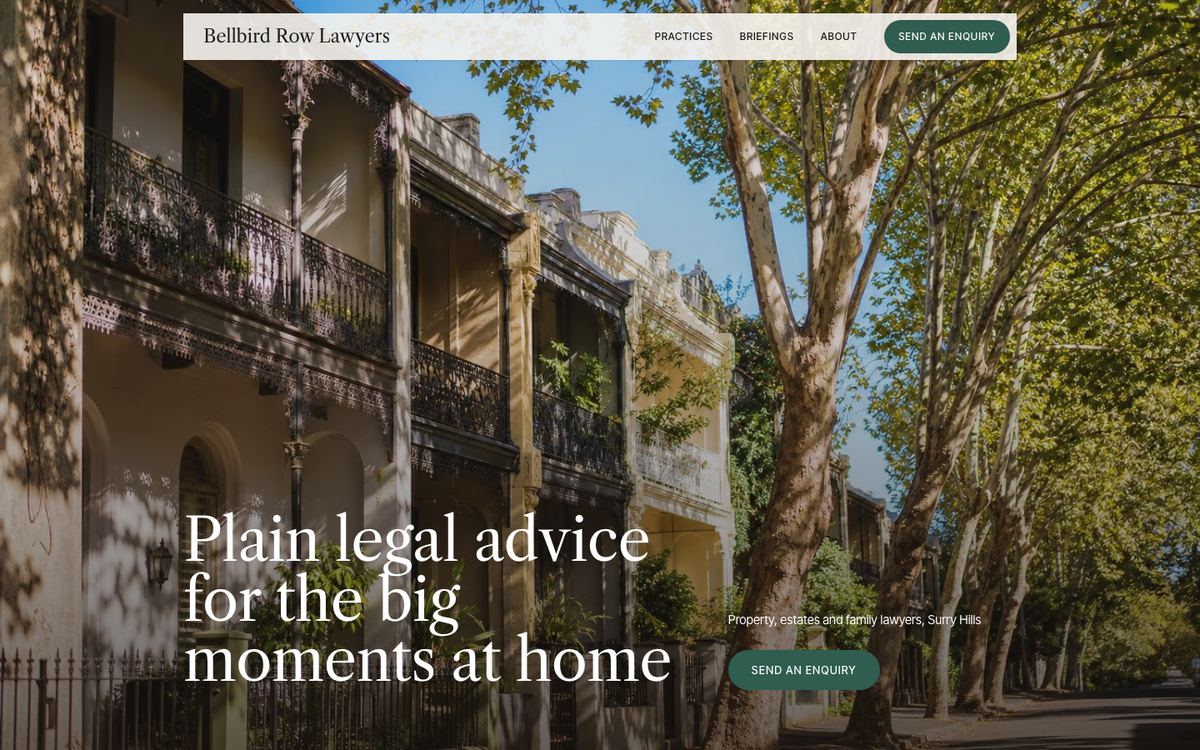
A street photograph and a centred serif
A bright street photograph under the whole first screen, with the firm's name set large and centred in a serif.
Sample design. Bellbird Row Lawyers is a fictional business.
-
Warm photographs on a calm grey ground
Full-width warm photographs under a pale floating header, and practice areas set as photograph rows.
Sample design. Bellbird Row Lawyers is a fictional business.
-

Cream paper and ruled cells
A cream ground and a quiet serif, small greyscale photographs and numbered practice areas in ruled cells.
Sample design. Bellbird Row Lawyers is a fictional business.
-

A headline down the photograph
A photograph fills the first screen and a very large headline runs down its side, its last words in the brand colour.
Sample design. Bellbird Row Lawyers is a fictional business.
-

A glass panel and fine hairlines
A still street photograph with the headline in a dark glass panel, and sections opened by a hairline and a small label.
Sample design. Bellbird Row Lawyers is a fictional business.
What goes wrong on older sites
- A price guide on the site that is lower than the figure the agent would tell a buyer in person.
- Sold prices shown without the date, which makes them look better than the current market.
- A home page that shows the same listings as the portals but none of the agents.
- A form that sends an appraisal request to an email inbox no one checks over the weekend.
- Suburb pages with the same paragraph on every suburb and the name swapped.
Questions from real estate agents
- What should a real estate agent's site show first?
- The agents, then the listings. An owner wants to see who they would be dealing with, and a buyer wants to see what you have. A request-an-appraisal button on every page captures the owner who has just decided to sell and is still looking at the page.
- Can the site show our sold prices?
- Yes, with the date and the address, and only where the figure is public record or the owner agreed. Remember that undated sold prices can mislead. Showing how long a property took to sell, with dates, is more honest than a single glossy number.
- How careful do I need to be with price guides?
- Very. Underquoting rules are set by each state, and Australian Consumer Law applies too. Keep the guide on the site the same as the one you give a buyer in person, update it if the vendor's expectations change and don't use language that reads as a lure.
- Should I put our commission on the site?
- Explain how fees and marketing costs are set out for an owner, even if the figure varies. Owners compare agents on cost and are wary of surprises. A plain page on what is included, and what is charged extra, tends to win the appraisal.
- Do I need suburb pages?
- Only where you have something real to say about the area and its sales. A page with the same words under every suburb name gains nothing. Add a suburb when you can show recent sales, name the streets you know and give an agent who works there.
- How do I stand out from the franchise down the road?
- With people and specifics. Show the agents who actually work the area, the way you run an open home and what a sale campaign includes. Franchise sites look similar, so a clear independent voice and honest local detail make an owner stop.
From AUD 1,500
Fixed before we start. No deposit. You pay when it's live.
- Your site goes live on your domain and you've got 7 days before the invoice is due.
- The first year of hosting and care is included. After that it's AUD 25 a month, billed yearly (AUD 300 a year).
- You edit your own words and photos, and your old site stays where it is until you're happy.
Get a quote We reply within 24 hours.