Websites for architects
Website design and development for architects across Australia: how a project runs from first meeting to handover, laid out in plain stages.
From AUD 1,500, fixed before we start. No deposit. You pay when it's live.
Get a Quote
What a site for architects has to do
People choose an architect by looking. They scroll through projects, find one that feels right and then check whether you've worked on something like theirs. So the portfolio is the home page, photographed carefully, with each project's brief and site described in a few honest sentences. The words matter less than the pictures, but they must be specific.
The second thing a client wants is to understand how it works. What does the first meeting cover, what do the stages involve, what are the fees based on and who will they deal with? A clear process page, along with a plain way to enquire, brings in the clients who've already decided they like your work.
What the site carries
- A portfolio on the home page, with each project given a title, a brief and the type of site.
- Photographs of finished work, shot well, with a plan or sketch beside the more complex projects.
- The architect's name, with the title shown as the relevant state or territory board allows.
- The project types you take on, such as new houses, extensions, renovations and small commercial.
- A process page that walks through the stages from brief to handover, in plain terms.
- How fees are set, such as a fixed fee, a percentage of construction cost or an hourly rate.
- A page for those starting out, saying what to bring to a first meeting and what it will cost.
- Your approach to the things clients worry about: budget, planning approval and builder selection.
- The people in the studio, with photos, and who a client deals with day to day.
- An enquiry form that asks for the suburb, the project type and a rough budget range.
The work your customers look for
- new houses
- home extensions
- renovations
- granny flats
- heritage alterations
- knockdown rebuilds
- townhouse and unit design
- small commercial fit-outs
- planning approval documents
- feasibility studies
What they type
- "architect"
- "residential architect"
- "home extension architect"
- "architect near me"
- "renovation architect"
- "how much does an architect cost"
- "architect for knockdown rebuild"
The rules that shape the words
The title architect is protected by state and territory boards, so use it only for a person who is registered with the relevant board.
Statements about experience, awards or projects must be accurate and able to be supported, since Australian Consumer Law bars misleading claims.
Photographs and descriptions of projects should be used only with the client's agreement and the photographer's permission.
Fees and offers on the site need their conditions stated, because an unclear price can be read as misleading.
Rules change. Have your licence and wording checked against your regulator before the site goes live.
Sample designs
The closest designs to a site for architects
We haven't built a sample for architects yet, so here's the nearest kit. Yours is built on your own words and photos.
-

A street photograph and a centred serif
A bright street photograph under the whole first screen, with the firm's name set large and centred in a serif.
Sample design. Bellbird Row Lawyers is a fictional business.
-
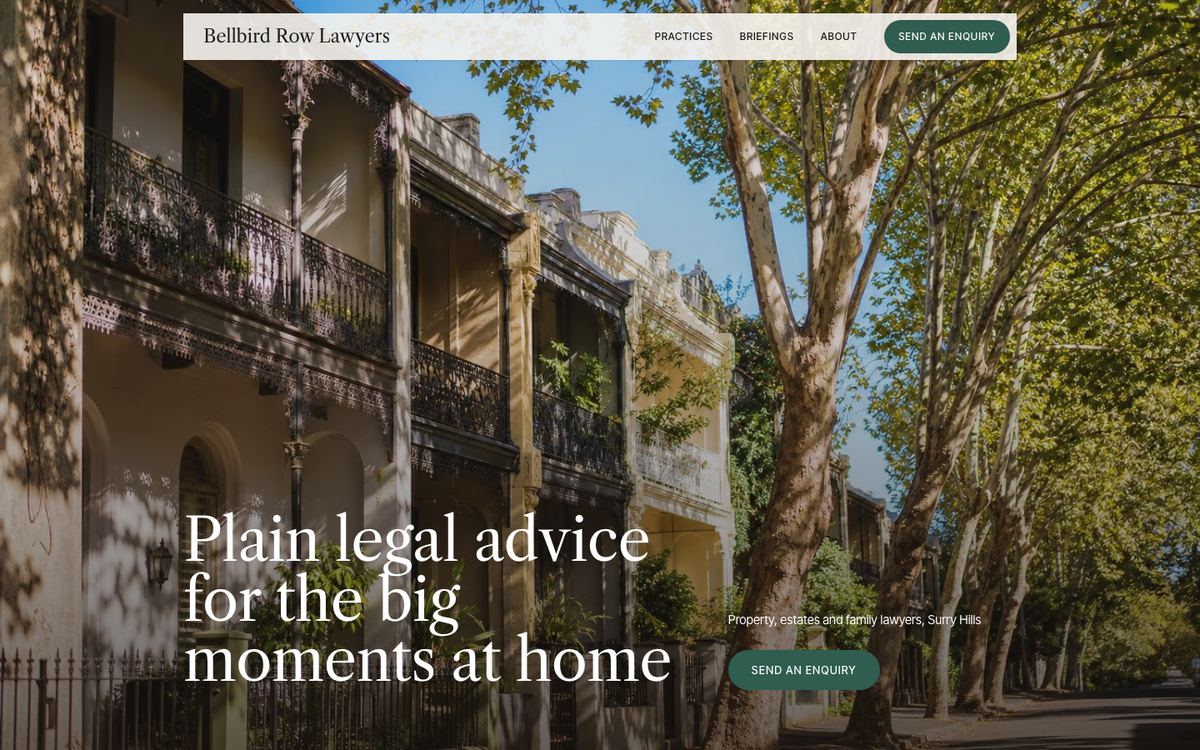
Warm photographs on a calm grey ground
Full-width warm photographs under a pale floating header, and practice areas set as photograph rows.
Sample design. Bellbird Row Lawyers is a fictional business.
-

Cream paper and ruled cells
A cream ground and a quiet serif, small greyscale photographs and numbered practice areas in ruled cells.
Sample design. Bellbird Row Lawyers is a fictional business.
-

A headline down the photograph
A photograph fills the first screen and a very large headline runs down its side, its last words in the brand colour.
Sample design. Bellbird Row Lawyers is a fictional business.
-

A glass panel and fine hairlines
A still street photograph with the headline in a dark glass panel, and sections opened by a hairline and a small label.
Sample design. Bellbird Row Lawyers is a fictional business.
What goes wrong on older sites
- Using the title architect for someone who isn't registered, which the boards protect.
- A portfolio of photographs with no words, so a visitor can't tell what the brief was.
- A slow home page choked by oversized images, especially on a phone.
- Project names with no location or type, so a client can't tell if it matches theirs.
- A contact page that is only an email address and a vague line about getting in touch.
Questions from architects
- How many projects should the portfolio show?
- Fewer, and better. Six to ten well-presented projects beat thirty thumbnails. Pick work that matches the jobs you want, give each a brief and a location, and show at least one project like the kind most clients are planning.
- Can I call myself an architect on the website?
- Only if you are registered with the state or territory board, which protects the title. If someone in the studio is a designer, describe them as that. Show registration details for the architect on the about page so clients can check them.
- Should the fee structure be on the site?
- Explain how they are worked out, even if you don't give a number. A client who knows whether it's a fixed fee, a percentage of construction cost or hourly will feel safer ringing. A page on the first meeting and what it costs removes the biggest barrier.
- Do I need a blog?
- Not unless you'll keep it going. A few case studies, each describing a project's brief, constraints and decisions, are more useful than news posts. They give a potential client a sense of how you think, and they give search engines something real to read.
- How do I handle client privacy with project photos?
- Ask the owner first and put it in writing, and credit the photographer. Some owners won't want their address shown, so name the suburb instead. If a client declines, show drawings or details without the house number or street.
- What goes on the enquiry form?
- The suburb, the type of project, a rough budget band and how they found you. Keep it short enough to finish on a phone. Too many questions put people off, and too few leave you ringing back for information that could have been in the form.
From AUD 1,500
Fixed before we start. No deposit. You pay when it's live.
- Your site goes live on your domain and you've got 7 days before the invoice is due.
- The first year of hosting and care is included. After that it's AUD 25 a month, billed yearly (AUD 300 a year).
- You edit your own words and photos, and your old site stays where it is until you're happy.
Get a quote We reply within 24 hours.